Counting in Twenties
For numbers forty and beyond, up until three hundred eighty, the original number pattern will repeat, with every number changing the number that goes in front of "-kipiaq." Sixty will be written as "piŋasukipiaq," eighty will be written as "sisamakipiaq" and one hundred will be written as "tallimakipiaq." They are combined in terms of five in a similar manner as the ones, as shown below.
| English | Iñupiaq | Literally | Audio |
|---|---|---|---|
| Twenty | Iñuiññaq | Twenty | |
| Forty | Malġukipiaq | Two twenties | |
| Sixty | Piŋasukipiaq | Three twenties | |
| Eighty | Sisamakipiaq | Four twenties | |
| One Hundred | Tallimakipiaq | Five twenties | |
| One Hundred Twenty | Tallimakipiaq Iñuiññaq | Five twenties and one twenty | |
| One Hundred Forty | Tallimakipiaq Malġukipiaq | Five twenties and two twenties | |
| One Hundred Sixty | Tallimakipiaq Piŋasukipiaq | Five twenties and three twenties | |
| One Hundred Eighty | Tallimakipiaq Sisamakipiaq | Five twenties and four twenties | |
| Two Hundred | Qulikipiaq | Ten twenties | |
| Two Hundred Twenty | Qulikipiaq Iñuiññaq | Ten twenties and one twenty | Not Available |
| Two Hundred Forty | Qulikipiaq Malġukipiaq | Ten twenties and two twenties | Not Available |
| Two Hundred Sixty | Qulikipiaq Piŋasukipiaq | Ten twenties and three twenties | Not Available |
| Two Hundred Eighty | Qulikipiaq Sisamakipiaq | Ten twenties and four twenties | Not Available |
| Three Hundred | Akimiakipiaq | Fifteen twenties | Not Available |
| Three Hundred Twenty | Akimiakipiaq Iñuiññaq | Fifteen twenties and one twenty | Not Available |
| Three Hundred Forty | Akimiakipiaq Malġukipiaq | Fifteen twenties and two twenties | Not Available |
| Three Hundred Sixty | Akimiakipiaq Piŋasukipiaq | Fifteen twenties and three twenties | Not Available |
| Three Hundred Eighty | Akimiakipiaq Sisamakipiaq | Fifteen twenties and four twenties | Not Available |
| Four Hundred | Iḷagiññaq | Four Hundred | Not Available |
You might have noticed that we just repeated the count from one to twenty, replacing the last letter of each word with the post-base -kipiaq. However, anywhere you would see atausiq get used will be replaced with the word for twenty, iñuiññaq.
Money Model: Part 3
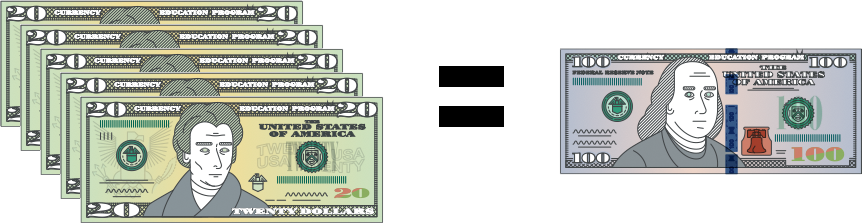
The second digit in the Iñupiaq counting system makes things quite a bit more complicated, because the language really starts to conflict with the base-10 arabic numeral system at this point. The number 40 is translated as malġukipiaq, but your first thought might be that, if sisamat is 4, sisamakipiaq should be 40. One method I use to keep myself straight is to think of each number in the second place value as a twenty dollar bill.
| Iñuññaq |  |
| Malġukipiaq | |
| Piŋasukipiaq | |
| Sisamakipiaq | |
And since we can change out five twenty-dollar bills for a hundred-dollar bill...
| Tallimakipiaq | 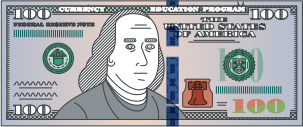 |
| Qulikipiaq | |
| Akimiakipiaq | |
We use all the words for five, ten and fifteen dollar, adding -kipiaq to the end, to represent one hundred, two hundred and three hundred dollars respectively.
Example 1: 296
Two one-hundred dollar bills = qulikipiaq
Four twenty dollar bills = sisamakipiaq
Three five dollar bills = akimiaq
One one dollar bill = atausiq
If we add that all up, we get 200 + 80 + 15 + 1, to get 296
Taking the words for each of those in that order, we get qulikipiaq sisamakipiaq akimiaq atausiq.
Example 2: 305
If any bills are not included, we simply don't include them in the words. For example, 305 would just be:
Three one-hundred dollar bills = akimiaq
One five dollar bill = tallimat
Which gives us 300 + 5, or akimiakipiaq tallimat.
Example 3: 129
For the second place value, we just use the word iñuiññaq anywhere we would use the word atausiq.
One one-hundred dollar bill = tallimakipiaq
One twenty dollar bill = iñuiññaq
One five dollar bill and Four one dollar bills ("almost" ten dollars) = quliŋŋuġtaiļaq
Since we "almost" had ten dollars, we replace the tallimat and sisamat (total of 9) that we would have had with quliŋŋuġtaiļaq. Putting everything together, we have 100 + 20 + 9 to get tallimakipiaq iñuiññaq quliŋŋuġtaiļaq.
"Almost" again
Any time we are one dollar away from being able to make a five, twenty or one-hundred dollar bill (with the exception of four, which is still sisamat), we use -ġutaiļaq at the end of the word. This will always happen at the end of the word string, but it can be a bit tricky to think about when you are one short of a number.
One important point is that it is specifically when you are only ONE short of the next number. 380 is twenty short of 400, so it still is stated as akimiakipiaq sisamakipiaq, even if that specific place value is one away from being the next place value.
279 is qulikipiaq sisamakipiaġutaiļaq
299 is akimiakipiaġutaiļaq
379 is akimiakipiaq sisamakipiaġutaiļaq
399 is iḷaġiññaġutaiḷaq
Regardless of how high the place values go, you will only use -ġutaiḷaq when you are only one short of a number in a higher place value.
Beyond 400
Four hundred marks the third place value in the Iñupiaq counting system, and past this we will repeat all of the numbers again, but using -agliaq instead of -kipiaq. This third place value will be combined with the words in the same manner, so 842 would be said as malġuagliaq malġukipiaq malġuk. Notice how each place value is doubling from the previous place value, even though the word for two is used in each of these words? This will continue to happen as we move into higher place values. This happens because this is a base-20 system. This disconnect between the Arabic numeral system and the language for counting ultimately led to the development of the Kaktovik numeral system.
Practice
Try levels 3 and 4 to practice the vocabulary for numbers 20 through 400. You can also try the higher levels to practice the vocabulary for numbers higher than 400. Click here to open the program in a new window.
References:
Maclean, E. A. (2014). Iñupiaq to English Dictionary. University of Alaska Press.